PECs V Visual Support (July 2026)
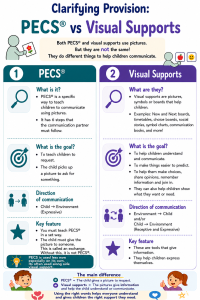
Clarifying Provision: PECS® vs Visual Supports
It has been identified through the quality assurance work around EHCPs that there may be some inaccuracies in terminology related to communication needs and distinguishing between the Picture Exchange Communication System® (PECS®) and the use of visual supports such as photos, symbols, communication boards etc.
While both use images, they serve entirely different functional purposes in a child’s learning environment:
- PECS® (Picture Exchange Communication System®)
- What it is: A highly specific, evidence-based expressive communication protocol broken into six distinct, prescriptive phases.
- The Goal: To teach functional, spontaneous communication. It trains the child to physically initiate an interaction by picking up a picture card and handing it to a communication partner to make a request or comment.
- Direction of Communication: Child -> Environment (Expressive)
- Key Feature: It requires explicit, structured training to implement correctly. Without the physical “exchange” element, it is not PECS®.
It has become less common, not because it is ineffective, but because communication support has evolved.
- Visual Supports
- What it is: Visual supports are evidence-informed communication and environmental adjustments that make information visible, reduce cognitive load, and increase predictability, understanding and independence. They support comprehension, memory, organisation, choice-making and participation across everyday activities. Examples include Now-and-Next boards, visual timetables, social stories, and choice boards, aided language displays (ALDs), clues books, communication books.
- The Goal: To improve understanding, reduce cognitive load and support communication, participation and independence. Visual supports help children anticipate what is happening next, understand routines and expectations, navigate transitions, process spoken information and make choices. They can also provide a means of expression, enabling children to point to, select or use symbols to communicate alongside speech, without following the structured teaching protocol of PECS®
- Direction of Communication: Environment -> Child and/or Child -> Environment (Receptive and Expressive)
- Key Feature: These are static tools that do not require an active communication exchange from the child to function.
To ensure children receive the communication support and resources specified in their EHCPs, it is important to distinguish between visual supports and PECS®. PECS® (Picture Exchange Communication System) is a registered trademark and refers to a specific, evidence-based intervention delivered using a structured teaching protocol. It should not be used as a generic term for symbol-based communication or visual supports. Where the intention is to provide visual supports or aided communication, EHCPs should describe these explicitly rather than referring to PECS® unless the structured PECS® programme is specifically required.
Why this distinction is important:
The level of adult support and specific training required for PECS® is much higher than for visual support, this could therefore lead to confusion and potentially conflict if PECS® is incorrectly identified as a provision within an EHCP.
The current perception of PECS® has also shifted significantly in recent years. While it remains a widely researched, evidence-based tool, it is currently the subject of intense debate within speech and language therapy, education, and the neurodiversity-affirming movement.
Modern practice has moved away from viewing PECS® as a “one-size-fits-all” solution for non-verbal children. Instead, professionals view it through a highly critical lens, balancing its proven benefits against modern, child-led communication philosophies. It is therefore even more important to make the distinction between the two where a conscious decision may have been made against the use of PECS®.
Many speech and language therapists now favour more individualised Alternative and Augmentative Communication (AAC) approaches that support a wider range of communication functions, such as commenting, asking questions and social interaction. Advances in speech-generating technology, alongside a greater emphasis on neurodiversity-affirming and person-centred practice, mean that many people now benefit from more comprehensive communication systems that can grow with their language and participation across different environments.
Recommendation:
PECS® should only be referenced and included as provision where it has been identified by a speech and language therapist as the most appropriate form of intervention for a child/young person.
Where PECS® has been identified in a report from a professional other than a speech and language therapist clarification should be sought from the author of the report on whether they are referring to visual support or whether there is specific evidence from a speech and language therapist recommending PECS® before this is included within EHCP provision
Direct Payments and Audits (July 2026)
We wanted to share some helpful updates from the Jigsaw Service about Direct Payments, including how they can be used to support your child’s assessed needs and agreed outcomes.
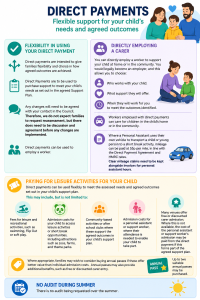
Flexibility in using your direct payment
- Direct payments are intended to give families flexibility and choice in how agreed outcomes are achieved.
- Direct Payments are to be used to purchase support to meet your child’s needs as set out in the agreed Support Plan. Any changes will need to be agreed with your contact in the Council. Therefore, we do not expect families to request reassessment, but there does need to be discussion and agreement before any changes are implemented.
- Direct payments can be used to employ a worker.
Directly employing a carer
You can directly employ a worker to support your child at home or in the community. You would legally become an employer, and this allows you to choose:
- Who works with your child.
- What support they will offer.
- When they will work for you to meet the outcomes identified.
Workers employed with direct payments can care for children in the child's home or in the community.
Where a Personal Assistant uses their own vehicle to transport a child or young person to a short break activity, mileage can be paid at 55p per mile, in line with the Direct Payment Agreement and HMRC rates. Clear mileage claims need to be kept alongside invoices for personal assistant hours.
Paying for leisure activities for your child
Direct payments can be used flexibly to meet the assessed needs and agreed outcomes set out in your child’s support plan.
This may include, but is not limited to:
- Fees for leisure and recreational activities, such as swimming, Flip Out or soft play.
- Admission costs for your child to access leisure activities or short break opportunities, including attractions such as zoos, farms, and theme parks.
- Community-based activities or after school clubs where these support the agreed outcomes in your child’s support plan.
- Admission costs for a personal assistant or support worker, where their attendance is needed to enable your child to take part.
Many venues offer free or discounted carer admission. Where this is not available, the cost of the personal assistant or support worker’s admission may be paid from the direct payment if this forms part of the agreed support plan.
Where appropriate, families may wish to consider buying annual passes if these offer better value than individual admission costs. Annual passes may also provide additional benefits, such as free or discounted carer entry. Up to two suitable annual passes may be purchased.
EBSA Part 1 (June 2026)
EBSA Part 2 (June 2026)